
How to choose an MVP development agency in London: A 12-point checklist
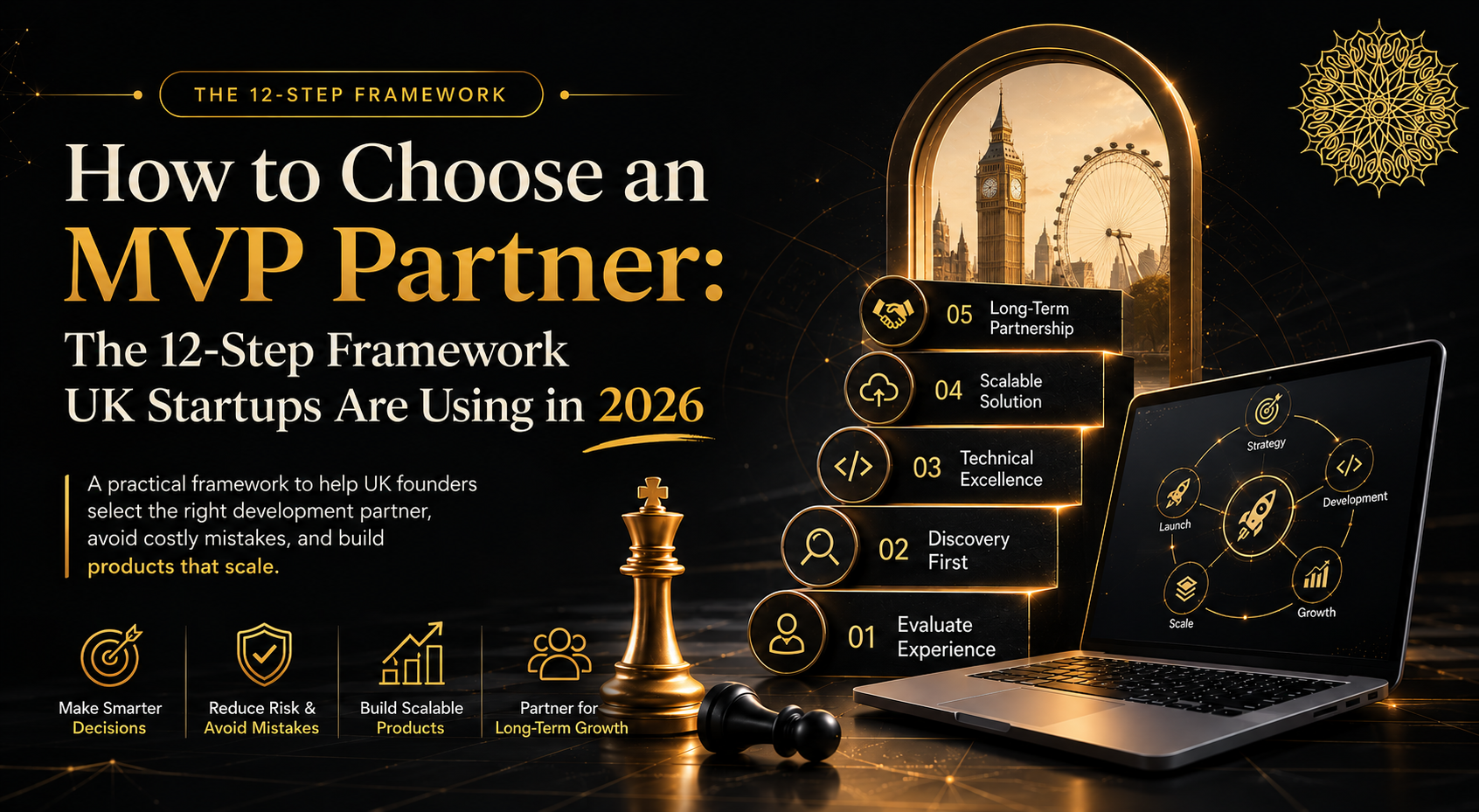
A practical 12-step framework for UK startups to choose the right MVP development partner in 2026 — covering scalability, SaaS architecture, AI readiness, technical execution, and long-term growth.
TL;DR
Choosing the right MVP development partner requires more than comparing pricing or delivery timelines. UK startups in 2026 are prioritising agencies that understand scalability, SaaS architecture, AI readiness, rapid iteration, and long-term product growth to avoid costly technical debt and rebuilds later.
The 12-Step Framework UK Startups Are Using in 2026
Many startup founders' actual reason to regret their first development hire is the build up of product without understanding how startups actually operate.
Across the UK, founders are launching SaaS tools, AI platforms, marketplaces, fintech products, and mobile applications faster than ever. Yet many still struck in the loop of finding the answer to:
How do you choose the right MVP development partner without wasting time, money, or momentum?
The answer is no longer just “hire developers.” Today’s startups need a technology partner that mainly understands product strategy, scalability, user behaviour, infrastructure, and rapid iteration. If you are searching for an MVP development agency as a London startup for long-term growth, this guide gives you a practical framework that goes beyond portfolios and pricing.
This is a structured 12-point checklist designed specifically for founders evaluating:
- A software development agency
- A startup software agency
- A SaaS development agency
- A mobile app development partner and other technical teams building modern startup products.
Nowadays most MVP Projects fail after technically launching. Very few evolve successfully.
The common reasons include:
- Weak architecture
- Rushed technical decisions
- Poor communication
- Non-scalable infrastructure
- Lack of product understanding
- Disconnected frontend/backend systems
Founders often optimise for Lowest quote, Fastest timeline or Biggest promises Instead of evaluating whether the partner can support actual product growth. This becomes especially dangerous once users increase, investors request changes, integrations become necessary and performance issues emerge. A startup MVP should not just prove the idea. It should create a stable technical foundation.
The 12-Step MVP Partner Evaluation Framework:
1. Evaluate Their Startup Experience, Not Just Their Portfolio
Enterprise experience does not automatically translate to startup execution.Startups move differently. A strong startup software agency founders work with should understand rapid iteration, lean execution, changing priorities, funding constraints & speed-to-market pressure
Ask:
- Have they worked with pre-seed or seed-stage companies?
- How do they manage evolving requirements?
- How do they balance speed versus scalability?
Startup product development is often chaotic.Your partner must be comfortable operating inside that uncertainty.
2. Check Whether They Prioritise Discovery First
A professional MVP development agency businesses trust will never jump directly into development. Good agencies begin with:
- Discovery workshops
- Product mapping
- Technical feasibility analysis
- Architecture planning
- User flow validation
This stage prevents expensive misalignment later.If an agency instantly gives fixed pricing without deep discovery, that is usually a warning sign.
3. Assess Their Technical Breadth
Modern digital products are multi-layered systems. A capable software development agency startups choose should ideally support frontend engineering, backend systems, mobile apps, DevOps, AI integrations and cloud infrastructure. This matters because startup requirements evolve rapidly.
A founder may initially request a web dashboard, but later requires mobile apps, AI recommendations, automation and analytics infrastructure. Technical flexibility becomes a competitive advantage.
4. Review Their Frontend Product Quality
Users judge credibility instantly whereas founders sometimes underestimate UX during MVP development. An experienced react development agency should demonstrate polished interfaces, responsive dashboards, scalable component systems,performance optimisation and intuitive onboarding flows.
For SaaS startups especially, frontend quality heavily affects:
- Activation rates
- Retention
- Investor confidence
Bad UI creates distrust even if the backend is technically strong.
5. Understand Their Mobile Development Approach
Many startups eventually expand into mobile ecosystems. Working with a capable flutter development agency can significantly reduce development cost, launch timelines and maintenance overhead. Flutter is increasingly popular because it supports Android & iOS and has faster iteration cycles. If mobile is part of your roadmap, evaluate:
- App performance
- Deployment workflows
- Scalability planning
- Offline support capability
Cross-platform speed matters for startups operating under limited runway.
6. Verify Their Backend Engineering Capability
Backend systems determine whether your product can scale under pressure. A strong Python development agency UK startups hire for modern backend infrastructure should understand:
- API scalability
- Async processing
- Automation pipelines
- AI integrations
- Cloud-native systems
This becomes especially important for: AI products, marketplaces, SaaS systems, fintech platforms and high-data applications.
Ask technical questions directly:
- How do they manage concurrency?
- What cloud architecture do they recommend?
- How do they prevent bottlenecks?
Serious agencies explain technical trade-offs clearly.
7. Evaluate Their SaaS Product Knowledge
Building SaaS products requires specialised operational understanding. An experienced SaaS development agency should already understand subscription models, role management, onboarding systems, tenant architecture, recurring billing and analytics dashboards. “Software” can be built by many agencies but very few can comprehend SaaS growth mechanics. This difference becomes visible very quickly after launch.
8. Check Their AI/ML Readiness
AI is now deeply integrated into startup ecosystems. Founders increasingly need:
- AI implementation capability
- Model integration knowledge
- Automation expertise
- ML infrastructure understanding
But founders should avoid agencies that treat AI like a marketing buzzword. A good partner explains:
- Where AI adds real value
- Where traditional systems work better
- Infrastructure implications
- Long-term operational costs
In reality, practical AI implementation matters more than hype.
9. Assess Their Communication Systems
Communication problems destroy startup momentum faster than technical problems.A reliable mobile app development partner should provide regular sprint demos, milestone visibility, shared project tracking, technical transparency and documented workflows. Founders should never feel disconnected from development progress. Ask:
- Who manages delivery communication?
- How are blockers handled?
- How often are sprint reviews conducted? Strong communication usually reflects strong operational maturity.
10. Review Their Scalability Thinking
This is one of the most overlooked areas in MVP development. Many startups build products that technically work but collapse under growth. A scalable b2B software agency should discuss infrastructure scaling, modular systems,API architecture, caching strategies, deployment automation, and database optimisation
Good architecture is invisible early. But critical later.
11. Look for Long-Term Product Partnership Potential
The best startup-agency relationships extend beyond launch. A quality MVP development partner should ideally support post-launch optimisation, maintenance, scaling support, AI expansion, and future hiring transitions. Avoid teams that only focus on “delivery.” Strong startups evolve continuously. Your technology partner should evolve with them.
12. Validate Their Real-World Execution Experience
Operational maturity matters more than case study. Look for evidence of complex integrations, high-scale systems, compliance handling, multi-platform products, AI implementation and infrastructure reliability.
Final Takeaway
The right MVP partner basically creates momentum and avoids technical debt. Founders should not evaluate agencies purely on pricing, turnaround time, or visual portfolios. Instead, they should assess product understanding, scalability thinking, communication quality, AI capability and operational maturity.
Because successful startup products are not built by accident. They are built through thoughtful technical decisions made very early. And in many cases, those early decisions determine whether a startup scales smoothly or spends years rebuilding what should have been built properly from the beginning.
Related reading
Next.js vs Plain React in 2026: A Strategic Framework for Modern Web Development
Choosing between Next.js and plain React in 2026 depends on your business goals. This guide explains when Next.js delivers better SEO, performance, and scalability for UK marketing websites, and when React is the smarter choice for internal applications. Learn how framework selection affects Core Web Vitals, long-term maintenance, and digital growth, helping you make an informed technology decision for your next web project.
3 min read
Agentic AI in Production: 3 Engineering Patterns That Repeatedly Fail and 3 That Consistently Work
Everyone is talking about AI agents. Very few are talking about what happens after deployment. The difference between a spectacular demo and a production-ready AI system isn't the language model. It's the engineering architecture around it. Drawing from industry guidance and real-world product delivery, this article explores six engineering patterns that repeatedly determine whether autonomous AI systems fail or scale.
6 min read
React Native vs Flutter in 2026: Choosing a Cross-Platform Stack for UK Startups
React Native and Flutter both offer powerful paths for UK startups building cross-platform applications in 2026. This guide compares their performance, scalability, development speed, ecosystem maturity, and long-term suitability to help founders choose the right technology stack for their product journey.
5 min read